On this page
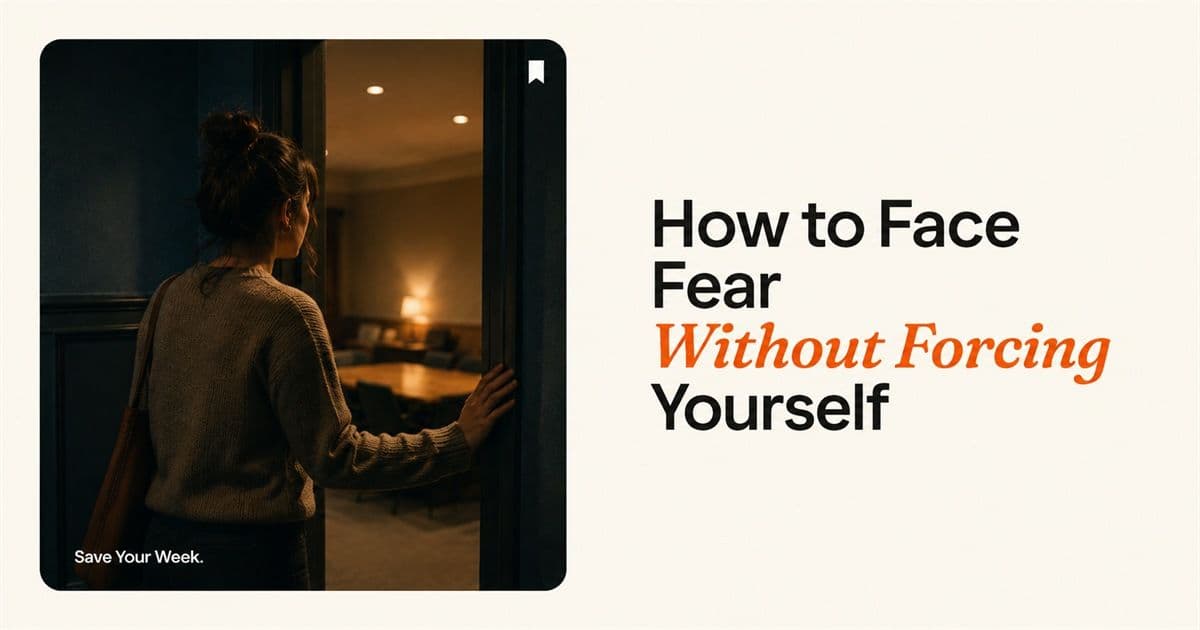
You keep postponing the conversation, application, appointment, or first day. Then you criticise yourself for being weak and set a dramatic challenge: “Tomorrow I will just do it.” Tomorrow arrives, the step still feels too large, and shame joins the fear. That cycle is why how to face fear needs a different measure than willpower alone.
How to face fear works better when courage is measured by a chosen, tolerable approach, not by how little fear you feel.
Avoidance can protect and restrict
Avoidance is not automatically irrational. Leaving real danger, delaying a conversation until both people are calmer, or seeking information before a medical decision can be wise. The problem is when avoidance repeatedly shrinks life while the feared prediction remains untested. How to face fear begins by noticing which kind of avoidance you are using.
A 2024 review of experiential avoidance examines its role across mental-health research. A separate meta-analytic review links psychological-flexibility processes with outcomes in Acceptance and Commitment Therapy. These findings support the importance of approach and flexibility, but a self-guided step is not exposure therapy and should not be presented as treatment. They also do not prescribe one method for how to face fear in every situation.
Who should be careful? Anyone facing immediate danger, severe panic, trauma-related symptoms, compulsions, or a medical risk. In those situations, how to face fear may need a qualified clinician and a formal safety plan.
How to face fear: make the fear concrete
“I fear networking” is broad. Specify what, when, and where: entering a room alone, introducing yourself, sustaining a conversation, or following up afterward. Ask who is involved and what you predict will happen. How to face fear gets clearer when the prediction is testable.
Perhaps the prediction is, “I will freeze and everyone will judge me.” Now the goal is not to guarantee approval. It is to gather evidence about one part of that prediction.
Why choose a smaller step? Not because you are avoiding effort, but because a step you can repeat produces more information than an heroic promise you never attempt. Kristin Neff's Self-Compassion offers a helpful lens: support yourself as you would support another person while still holding the commitment. Compassion reduces needless attack; it does not remove accountability. That support is part of how to face fear without forcing collapse.
Connection of fear to the rest of life
A feared work conversation can affect Sleep. Avoiding a health appointment can affect Movement or Food. Fear of rejection can keep People at a distance and limit Growth. These Life Links help identify the cost of doing nothing and the support needed to approach. Balencia can keep those links visible so how to face fear is not treated as a character test.
Do not score the whole person as brave or cowardly. Judge a specific situation: what was the prediction, what Action was chosen, what happened, and what should change next time? That is how to face fear with evidence.
After the step, compare prediction with outcome. Perhaps the feared event did not happen, or it happened partly and you coped better than expected. Perhaps the step was too large, the setting was wrong, or the risk was real. Each result changes the next Plan. The goal is not to “prove fear wrong”; it is to build a more accurate relationship with risk and your capacity.
Repeat only when the step remains safe, chosen, and useful. Choice still matters. How to face fear without choice is pressure, not courage.
Distinguish discomfort, danger, and overwhelm
Fear advice becomes unsafe when it treats every alarm as something to push through. Discomfort is unpleasant but may be tolerable. Danger involves a credible threat to physical, emotional, financial, or legal safety. Overwhelm means the chosen step exceeds current capacity even if the situation is objectively safe. How to face fear depends on which category you are in.
These categories need context. Speaking in a meeting may be uncomfortable for one person and unsafe for another whose workplace punishes dissent. Contacting a family member may be a growth step in one relationship and a serious risk in an abusive one. A coach or article cannot decide that from the behaviour alone.
Ask what evidence supports the threat, what support changes the risk, and who is qualified to advise. Where danger is credible, protection is courage. Where the situation is safe but the step overwhelms you, reduce the dose or seek clinical support. That judgement is still how to face fear.
Build a ladder around behaviour, not confidence
Confidence often arrives after experience, so do not make it the entry requirement. Define steps an observer could recognise. For a feared presentation, the ladder might be opening the file, speaking the first paragraph alone, recording it, presenting to one trusted person, then joining the full setting. That ladder is how to face fear in practice.
Each step should answer one prediction. If you fear forgetting every word, a short recording tests recall. If you fear visible anxiety, speaking to a trusted person tests whether anxiety prevents communication. If the real fear is hostile treatment, private rehearsal does not test it; you need a workplace or safety response.
Keep the step large enough to provide information and small enough to repeat. Repetition under suitable conditions is more informative than one dramatic attempt followed by months of avoidance. Cia can help revise the ladder after evidence arrives, which keeps how to face fear iterative rather than heroic.
Review what you learned, including limits
Afterward, record the predicted outcome, what happened, what helped, and what you would change. Do not report only whether fear fell. It may stay high while your ability to act improves. How to face fear includes learning from limits.
A result can also confirm part of the concern. Someone may respond poorly, the environment may be unsupportive, or the physical symptoms may require assessment. Facing fear is not a commitment to interpret every result positively. Accurate learning can lead to a boundary, accommodation, treatment, or different Goal.
If you use a 0-10 fear rating, compare a specific moment with itself over time. Never turn the number into a whole-person courage score. How to face fear is scored by the situation, not by identity.
Your four-minute Action
Create a three-step approach ladder:
Tiny: a step that causes some discomfort but feels safe and possible.
Middle: a step for later, after reviewing the first.
Full: the outcome you ultimately want.
Complete only the Tiny Action now if appropriate: open the booking page, draft the first sentence, stand outside the venue for two minutes, or ask a trusted person for support. Record fear before and after on a simple 0-10 scale, but do not treat the number as a score of you. That Tiny Action is how to face fear today.
The benefit is evidence. Fear may remain; you learn whether you can move with it.
A coach can help make the step specific, check that it aligns with your Goal, and follow up. In Balencia, the person confirms the Action. A coach must not pressure someone into danger or imitate clinical exposure treatment.
Keep the ladder private if public accountability adds pressure rather than support. The right witness is someone who respects safety and the size of the step, not someone who turns courage into entertainment. Support should increase choice, not make retreat feel humiliating. That is how to face fear with dignity.
Frequently Asked Questions
Do I have to feel ready before learning how to face fear?
No, but you need enough safety and capacity for the chosen step. “Not fully ready” differs from “at risk.” How to face fear still requires a safe dose.
What if the first step of how to face fear increases my fear?
Pause and review the size, setting, and support. Increased fear does not automatically mean failure, but overwhelming distress is a reason to stop and seek qualified guidance.
Is distraction always avoidance of how to face fear?
No. A planned break can restore capacity. The question is whether you return to the chosen issue or use distraction indefinitely.
When should I seek therapy instead of self-guided how to face fear?
Consider qualified care when fear is severe, persistent, trauma-linked, or restricts daily functioning. Urgent safety or self-harm risk requires immediate local help.
Sources
Kristin Neff, Self-Compassion
Why Do We Become the Person We Once Hated?
Why Emotions Control Decisions and How to Pause
A Crowded Week Is Not a Failed Week
Tags
Did you find this article helpful?
About the author

Written by
Hamza Muqeem
Published
Put this into practice
Balencia turns advice like this into a plan that adapts to your week — with an AI coach that actually remembers what you told it.
Start free