On this page
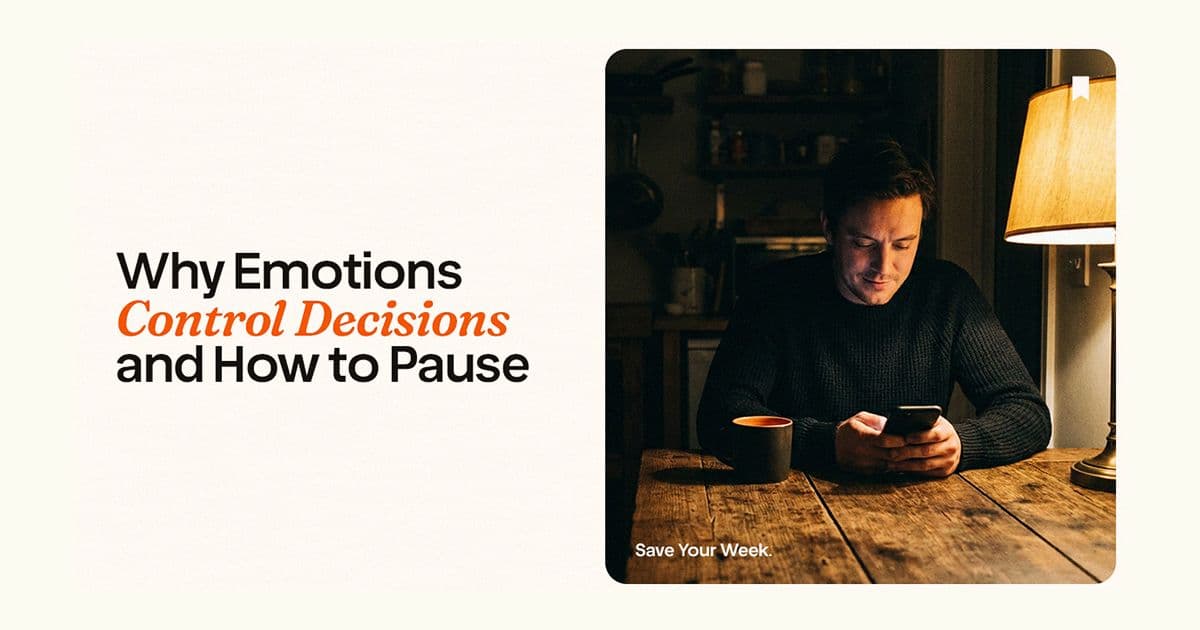
The email feels insulting, so you type a reply. The purchase promises relief, so you tap pay. The conversation feels uncertain, so you end it before the other person can. That is a live example of why emotions control decisions: the feeling changes what looks obvious before you have checked the cost.
Why emotions control decisions is not a question about personal failure. Emotions influence what you notice, remember, predict, and value in that moment. Understanding why emotions control decisions helps you stop treating a temporary state as the only available evidence.
A major review of emotion and decision making describes emotions as powerful, predictable influences on judgement and choice. Another research review examines how emotion can shape perception, attention, memory, and decisions. This research helps explain why emotions control decisions, but it does not make every emotional choice wrong. Fear can mark risk. Anger can mark a crossed boundary. Problems arise when one signal becomes the whole case.
The moment when one option feels certain
Under high activation, send, resign, buy, accuse, promise, or withdraw can feel unusually obvious. Later, when sleep or intensity changes, the same option may look different. That change is part of why emotions control decisions. “Trust your feelings” and “ignore your feelings” are both incomplete.
A useful gap starts with better labelling than “bad.” Precise language helps you see why emotions control decisions in a particular moment. Separate what you know from what you are assuming. Then match the speed of the decision to what becomes hard to reverse. Who will carry the effect, including your future self? When did the urgency begin? Where are you deciding: after midnight, during conflict, in a shop, on social media, or after a demanding workday?
One charged choice does not settle much. A repeated link can show why emotions control decisions across your week. Conflict late at night may predict messages you regret, or Wealth choices may speed up after professional criticism. Look for a pattern, not only one bad reply.
In Permission to Feel, Marc Brackett emphasises recognising and labelling emotions with greater accuracy. That skill may clarify why emotions control decisions, but it is not a diagnostic test. A 2024 workplace meta analysis found moderate training effects that often persisted beyond three months, though studies varied and many were methodologically weak.
Why emotions control decisions across the rest of the week
Balencia keeps the activation visible beside the Chapters it touches. That timeline can reveal why emotions control decisions in your week. A Peace entry can show the state. Sleep records can show whether the choice lands after a broken night. Wealth, People, or Growth records can show what the Action will change next.
You record the insulting email and the reply you nearly sent. Cia compares them with your Peace, Sleep, People, and Wealth records, then scores how strongly that sequence matters to your Goal. The explanation shows why emotions control decisions under this pressure instead of judging your character.
The score turns why emotions control decisions into a practical question. Should you act now, ask one question, or set a specific review time? That is how to pause before reacting when emotion is narrowing the available choices.
When Cia reviews why emotions control decisions, several parts of the week may have shifted together:
why emotions control decisions becomes clearer after short sleep or conflict;
irreversible Actions are chosen at the peak of the feeling;
Wealth or People consequences appear after the state has cooled;
no draft, hold, or pause sits in the week when the same trigger repeats.
You may have called that poor self control. The connected records show why emotions control decisions when peak activation meets an irreversible move with no matching safeguard. Regret after an emotional decision is useful evidence for Cia, not a character verdict.
A pause sized to the consequence
Cia’s revision uses the pattern behind why emotions control decisions. It matches the safeguard to the decision instead of delaying every choice.
That can look like:
a three line pause before one named decision type: state, story, stake;
sleep protection before evenings when conflict usually produces regret messages;
a Wealth or People safeguard for irreversible moves, such as a draft, a hold, or written confirmation;
a short review after the feeling changes, so process and outcome are not confused.
Immediate danger is different. Move to safety and contact appropriate local support. A coaching pause does not replace that.
Before the next high impact decision, write three lines: the emotion and body signal, the meaning you have not verified, and what becomes difficult to reverse if you act now. This exercise makes why emotions control decisions visible before you choose to act, ask one question, or set a review time. Later decisions show whether the safeguard reduced regret or whether Cia needs a different adjustment for that decision type under stress.
Talk to Cia before your next high impact decision. Ask Cia to review why emotions control decisions in that situation, weigh the emotional state beside the stake, and set a pause that matches the consequence.
Frequently Asked Questions
How long should I wait before making an emotional decision?
There is no universal rule. Understanding why emotions control decisions can help you match the pause to urgency and reversibility: minutes for a message, a night for a purchase that is not urgent, or longer for a major commitment.
Are intuitive decisions emotional decisions?
Intuition can combine emotion, pattern recognition, and experience. This is another reason why emotions control decisions without making every decision wrong. Intuition may be useful, especially in familiar settings, but confidence is not the same as accuracy.
What if my emotion is warning me about danger?
Prioritise safety. Understanding why emotions control decisions should never require staying in immediate danger. Move to safety and contact appropriate local support.
Can emotional intelligence improve?
Research on training suggests it can, but programmes and measures vary. Practising precise labelling, perspective taking, questions, and review may help you notice why emotions control decisions. That is more useful than chasing a flattering label.
Sources
Marc Brackett, Permission to Feel
Gym as Emotional Escape: Keep Training Without Hiding Feelings
How to Let Go of Difficult Emotions Without Ignoring Them
Does Eating Late Affect Sleep? Look Beyond One Dinner
Tags
Did you find this article helpful?
About the author

Written by
Hamza Muqeem
Published · Updated
Put this into practice
Balencia turns advice like this into a plan that adapts to your week — with an AI coach that actually remembers what you told it.
Start free