On this page
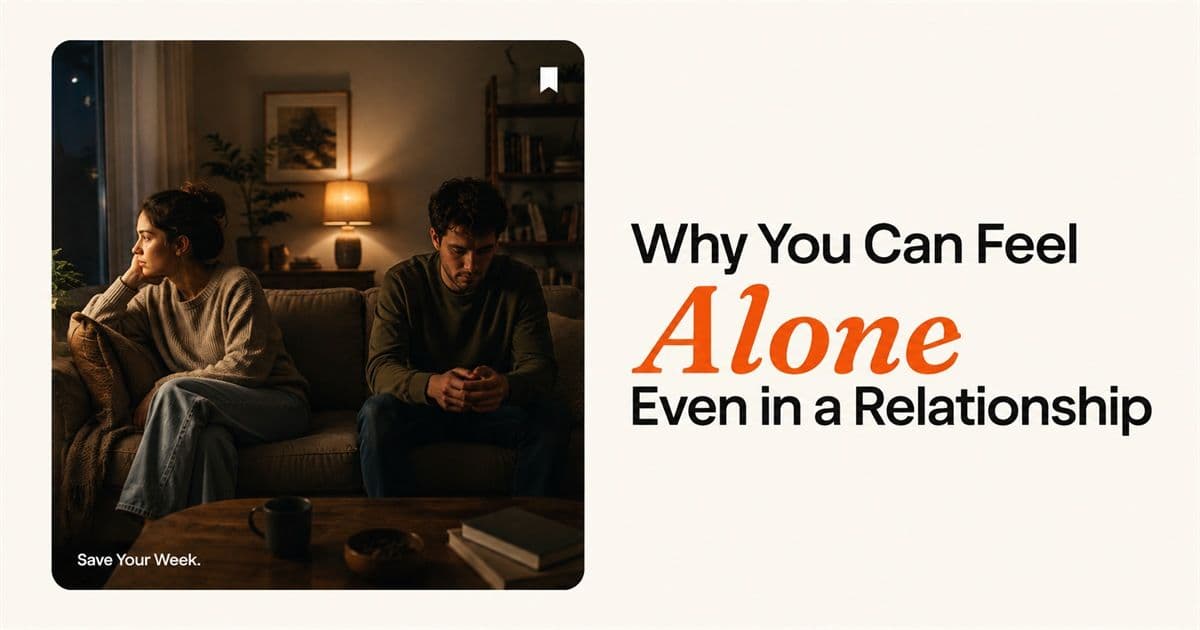
You share a home, a calendar, meals, and messages. From outside, you are clearly together. Yet when something matters, you do not know how to reach each other. Feeling alone in a relationship often begins in that gap between proximity and contact that lands.
Feeling alone in a relationship does not automatically mean the relationship is over or that either person is defective. It means contact is not currently producing the kind of connection you need, and that needs a closer look.
Proximity is not the same as connection
The World Health Organization's social-connection report distinguishes different dimensions of connection. A person can have contact and still experience loneliness. More time together is therefore not always the answer when you are feeling alone in a relationship.
A 2024 study across close relationships found that loneliness was associated with perceiving partners as less caring and admiring, and that this bias could contribute to lower relationship quality and persistent loneliness. This was a multi-study project, not a diagnosis of any couple. Perception can be biased, and partners can also genuinely be unresponsive. Both possibilities matter when you are feeling alone in a relationship.
The important move is to test what “alone” means in your situation.
Feeling alone in a relationship, name the missing form of connection
Who do you want to reach, the partner in front of you, a friend, family, community, or yourself? One relationship cannot supply every kind of belonging. Feeling alone in a relationship may be about one missing form of contact, not every form.
What is missing: attention, affection, practical support, emotional understanding, shared meaning, honest conflict, or reliable follow-through? When is loneliness strongest, after work, during social events, in bed, or when you share good news? Where do attempts at connection fail? Why might each person be unavailable? How could one observable behaviour change the moment?
“Be more present” is difficult to act on. “When I share something important, please put the phone down for ten minutes and ask me one question” is testable. That specificity turns feeling alone in a relationship into something you can review.
This issue travels through People, Peace, and Sleep. Late-night disconnection can disturb sleep; exhaustion can make attention harder the next evening. That Life Link suggests more than one possible intervention, not one cause. Balencia can keep those Chapters visible when feeling alone in a relationship keeps returning.
Look at the cycle, not only the person
In The Good Life, Robert Waldinger and Marc Schulz use decades of relationship research to argue for the importance of relationship quality. The book offers a valuable reflection lens, though findings from one long-running cohort should not be treated as universal across cultures and circumstances.
Instead of “You never care,” map the cycle: you hint, your partner misses it, you withdraw, they assume you need space, and distance grows. Or you ask directly, they dismiss you repeatedly, and the evidence points toward a boundary rather than a communication trick. Feeling alone in a relationship often lives inside that cycle.
Mixed outcomes matter. One better conversation is encouraging, not proof that the problem is solved. Repeated dismissal is also data.
Connection should be reviewed from both directions. Ask not only “Do they understand me?” but also “Have I made the need visible, and how do I respond when they reach for me?” This does not create equal blame. It checks your available contribution while leaving the other person's responsibility intact. Sometimes the answer is a new habit; sometimes it is grief about a relationship that cannot provide what is needed. Feeling alone in a relationship can be either signal.
Loneliness can hide inside efficient partnership
Some relationships function well as systems. Bills are paid, children are collected, meals are organised, and calendars align. The practical partnership may be strong while emotional contact has become rare. Neither fact cancels the other. Feeling alone in a relationship can coexist with excellent logistics.
This can make loneliness harder to name because there is abundant evidence of cooperation. Start by distinguishing coordination from felt responsiveness. When you share worry, does the other person notice and stay? When something goes well, can you celebrate together? Can either person ask for comfort without immediately receiving advice, correction, or a competing problem?
Practical teamwork is worth protecting. The goal is not to devalue it, but to notice which form of connection needs attention when you are feeling alone in a relationship.
Use requests that reveal compatibility
A clear request is not only a communication tool; it creates evidence about willingness and capacity. Ask for something specific, reasonable, and relevant: ten uninterrupted minutes, a weekly walk, affection on arrival, or a conversation before making a shared decision. That request tests feeling alone in a relationship against behaviour.
Then observe more than the first answer. Does the person negotiate honestly if the request does not fit? Do they remember, repair after missing it, and make an effort? Or do they mock the need, agree only to end the conversation, or punish you for raising it?
You are not testing whether a partner can perform perfectly. You are learning whether the relationship can respond to an important need through dialogue and follow-through. A repeated need deserves a direct answer, even when the relationship works well across many other areas of life. Cia can help you place one request and one review point in the week when feeling alone in a relationship keeps scoring high.
Build connection beyond the couple without avoiding the couple
Friends, family, faith communities, colleagues, and groups can provide forms of belonging a partner cannot. Expanding connection can reduce the pressure on one relationship and restore parts of identity. It does not erase feeling alone in a relationship if the loneliness is specifically about the partnership.
It should not become a way to keep the central problem permanently unspoken. If the loneliness is specifically about the partnership, support elsewhere can strengthen you for an honest decision, but it cannot answer the partner's willingness on their behalf.
Review safety and power. If attempts to connect lead to intimidation, surveillance, humiliation, or control, the problem is not a better date night. Seek specialist support. Where both people are willing but stuck, qualified couples therapy may help map the cycle and practise new responses.
If the answer stays unclear, agree on a review point instead of extending uncertainty without limit. Feeling alone in a relationship deserves a deadline for review, not endless hope without evidence.
Your four-minute Action
Complete this request:
“When ___ happens, I feel disconnected. Could we try ___ for ___ minutes, then check whether it helped?”
Choose one specific moment and one small behaviour. Examples include a ten-minute phone-free check-in, one walk, or asking before offering advice. The benefit is converting feeling alone in a relationship from a total verdict into something both people can observe.
A coach can help clarify the Goal, identify the connected Chapters, and review what happened after the request. In Balencia's model, the coach cannot decide what your relationship means. You confirm the Action and retain agency.
Do not use one missed request as a complete verdict. Choose a reasonable observation period based on the need, then review responsiveness, repair, and follow-through. Closeness grows through repeated moments, and repeated absence of care also deserves to be named without minimising it. That review is how feeling alone in a relationship becomes actionable.
Frequently Asked Questions
Is feeling alone in a relationship proof that my partner does not love me?
No. Feeling alone in a relationship may reflect mismatched needs, habits, stress, perception, conflict, or genuine unresponsiveness. Look for repeated evidence and talk safely.
Can I keep feeling alone in a relationship if we spend every day together?
Yes. Frequency of contact and felt understanding are different dimensions of connection. Feeling alone in a relationship can persist inside busy shared days.
Should my partner meet all my emotional needs?
No single person can usually provide every form of support. Close relationships matter, and wider friendships, family, community, and professional support may also matter. Feeling alone in a relationship still deserves a direct conversation about the partnership itself.
When is couples therapy appropriate for feeling alone in a relationship?
Consider qualified help when the pattern is persistent, distressing, or difficult to discuss safely. If abuse or coercive control is present, seek specialist safety support; joint therapy may not be appropriate.
Sources
Robert Waldinger and Marc Schulz, The Good Life
Acceptance vs Giving Up: Stop Fighting Reality
How to Face Fear Without Forcing Yourself
Tags
Did you find this article helpful?
About the author

Written by
Hamza Muqeem
Published · Updated
Put this into practice
Balencia turns advice like this into a plan that adapts to your week — with an AI coach that actually remembers what you told it.
Start free