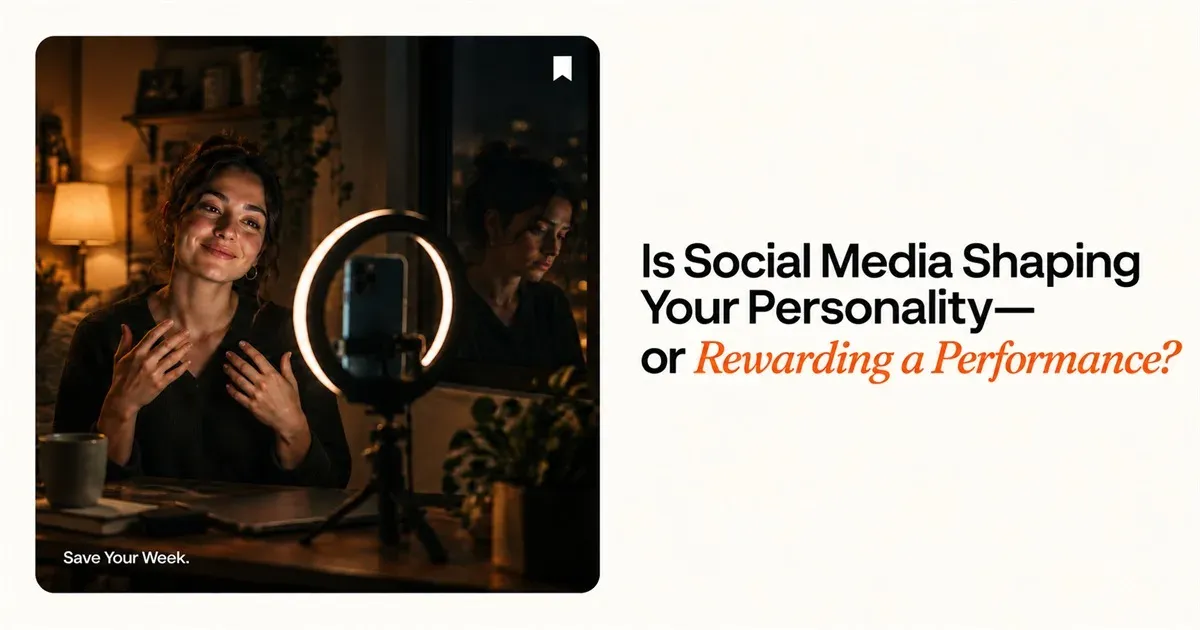
Your feed says you are productive, stylish, outraged, disciplined, spiritual, or always improving. Offline, you may be quiet, unsure, playful, tired, or interested in things you never post. After enough time online, one question can become hard to ignore: is social media shaping my personality?
The honest answer is not a simple yes or no. Social media can influence what you notice, repeat, value, and show to other people. Platforms can reward one version of you until that version gets more practice than the rest. But your feed is not a complete personality test. It is a limited prediction built from selected actions inside a system designed around attention.
That distinction matters. A feed is not a perfect mirror, but it is not harmless either. Look at who it affects, what changes, when and where influence grows, why it happens, and how you can respond.
Who is most likely to ask, “Is social media shaping my personality?”
Anyone who uses social media can feel its influence, but the experience is not the same for everyone. Age, work, relationships, health, culture, platform design, and current stress all affect how a feed lands.
Young people often use social media while exploring who they are, what they value, and where they belong. A review of social media and identity focuses on teens and young adults up to age 26. It shows why online identity deserves care, but it does not prove that each young person changes in the same way. We also cannot apply every finding to older adults.
Creators and people with public jobs face added pressure because online work can affect income and reach. If anger draws views, they may sound angry more often. If polished routines gain followers, doubt can feel off-brand. People going through change may also find ready-made roles appealing. These roles can offer words and support, but they may not fit life away from the screen.
Loneliness, stress, and poor sleep can make feedback feel more important. Online connection can be real and valuable. The risk begins when approval becomes the main evidence you use to decide who you are. For these groups, “is social media shaping my personality?” deserves a closer look at context, not a quick label.
What changes when I ask, “Is social media shaping my personality?”
To answer “is social media shaping my personality?”, first separate personality, identity, behaviour, attention, and performance. People often use these words as if they mean the same thing. They do not.
Personality means broad patterns in how you think, feel, and act. Identity includes your roles, values, groups, and life story. Behaviour is what you do in one setting. Performance is the part you show an audience.
Social media may shape behaviour without rewriting your whole personality. You may speak more confidently on video because the platform rewards clear opinions. You may join more arguments because anger keeps you engaged. Repetition makes actions familiar, but it does not prove they describe every part of you.
Platforms also shape attention. They watch when you view, pause, search, follow, share, comment, or skip. The feed reacts to those signs. If you pause on an upsetting post, it may show you more like it. The topic can then feel central to your life, even when your first pause came from shock, fear, or simple interest.
This creates a feedback loop:
You pause on a type of content.
The platform supplies more of it.
The topic becomes easier to notice.
You react again because it is now familiar.
The system treats that reaction as more evidence.
That loop can influence your mood and choices. It still does not prove the platform knows your complete self. It cannot see a private joke, a value you protected quietly, or a hobby you enjoy without taking a photo.
A systematic review of YouTube recommendation research found mixed evidence and noted limits in data and study methods. We cannot see every rule behind these systems. “Is social media shaping my personality?” remains a useful review question, not a diagnosis or a settled verdict.
When should I ask, “Is social media shaping my personality?”
Timing can matter more than total screen time. Ten minutes at a weak moment can affect you more than an hour of planned use.
Morning and night can both increase influence. A feed opened before you check your own plans can set the day’s emotional tone. At night, fatigue can make comparison harder to place in perspective. If “is social media shaping my personality?” appears most often in bed, review Sleep and Peace together.
Influence can also grow during uncertainty. Repeated career paths, relationship rules, body ideals, or productivity systems can start to look universal. Frequency is not proof that an idea fits your life. It may only show what the platform distributes well.
Metrics create another turning point. Repeating a format that works may be a sound work choice. The problem begins when “People liked this post” becomes “This is who I must be.” After conflict or rejection, watch for the same shift. Helpful words may bring clarity, while an endless stream of agreement can narrow your view before you check the facts.
Where should I look when asking, “Is social media shaping my personality?”
The obvious answer is “on the app,” but the effect can travel far beyond the screen. It can appear in your bedroom, work, clothes, close bonds, spending, meals, exercise, and self-talk.
It may show up in the bedroom when one more scroll replaces sleep. It may appear at the table when a meal becomes content before it becomes an experience. It may enter the gym when movement feels incomplete without a record. It may shape a conversation when you listen for a phrase you can post rather than staying with the person in front of you.
The effect can follow you into work and private thought. A creator may spend more time packaging an idea than testing whether it is useful. You may mentally write a caption during an experience, judge a quiet day as wasted because it produced nothing shareable, or take a firm position before you have time to think. In these moments, the audience remains in your attention even when the phone is down.
In Balencia terms, “is social media shaping my personality?” can cross several Chapters. A productive feed may support Growth while reducing Sleep. A beauty feed may inspire one person and increase comparison or spending for another. The content category alone does not decide the outcome.
Where influence appears also tells you what kind of response may help. If the problem lives mainly in bed, a phone boundary may matter. If it appears in work, separate professional posting from private exploration. If it appears in relationships, protect device-free contact. If it appears in spending, add a pause between inspiration and purchase.
Why does “Is social media shaping my personality?” feel so convincing?
Platforms work with what they can measure. Views, watch time, pauses, comments, saves, shares, follows, and clicks create visible signals. Your private values, quiet acts, and mixed feelings are much harder to count.
As a result, the measurable self receives more feedback. A sharp opinion produces comments. A polished routine earns saves. A dramatic change creates a clear before-and-after story. A patient conversation, a private creative attempt, or a calm decision may produce no public metric at all.
This does not mean platforms secretly assign you a fixed identity. Their systems react to the actions they can see. Your goal may be friendship, learning, or expression. The platform may want you to keep using it. Those goals can overlap, but they are not the same.
Audiences also reward clear, consistent roles: the fitness person, the business person, or the honest friend. A full human being is less tidy. You can value ambition and need rest. Repeating a successful role may make practical sense, but a useful public role remains partial. Trouble starts when you reject interests that confuse the brand or hide changes that might disappoint the audience.
Positive feedback can create connection, support a skill, or open an opportunity. Not every online performance is fake. Still, “is social media shaping my personality?” should lead to evidence: what does the platform reward, what do you repeat, and what does that repetition cost?
How can I answer, “Is social media shaping my personality?” with evidence?
You do not need a dramatic detox to learn something useful. To answer “is social media shaping my personality?”, start with a small audit and one offline experiment.
Step 1: Separate what you chose from what the feed rewarded
Open ten recent posts you saved, shared, liked, or watched for a long time. Label each one:
Chosen: This reflects a value or interest I practise offline.
Rewarded: This mainly reflects attention, approval, status, or work performance.
Accidental: This grew from curiosity, conflict, or one unusual click.
Do not use the labels as moral grades. A rewarded post may support your work. An accidental interest may become meaningful. You are simply checking the quality of the evidence behind the feed.
Step 2: Compare your feed-self with your lived-self
Write down three traits someone might infer from your profile. Then add one piece of offline evidence for and against each trait.
If your profile says “runner,” ask whether you enjoy running without tracking it. If it says “entrepreneur,” notice which tasks you choose when nobody sees them. If it says “relationship-focused,” compare posts about connection with the time you spend in real conversations.
The goal is not to expose yourself as fake. Public expression always selects. Use “is social media shaping my personality?” to stop one selected version from becoming your only version.
Step 3: Test one identity offline
Herminia Ibarra’s Working Identity looks at how small tests and close bonds can shape a career change. The book does not explain all identity, but its test-and-learn idea helps here.
Choose one feed claim and test it without public feedback. Cook without photographing the meal. Attend a class without announcing it. Read outside your normal recommendations. Take a walk without tracking it. Spend time with someone whose interests differ from your feed.
Afterward, record enjoyment, effort, attention, and whether you want to repeat it. This lived evidence gives “is social media shaping my personality?” a result the feed cannot provide.
Step 4: Change one input for seven days
Mute one account that reliably leaves you ashamed or agitated. Search for a neglected interest. Follow a source that adds context rather than outrage. Remove the app from the bedroom, or turn off one type of notification.
Change only one or two things. If you rebuild the whole feed, you will not know what affected the result. A small test gives “is social media shaping my personality?” clearer evidence.
Step 5: Replace the job the feed was doing
Every repeated habit has a job. Scrolling may provide rest, belonging, news, ideas, comfort, or escape. Asking “is social media shaping my personality?” will not help for long unless you replace that job.
If you used the feed for company, message a trusted person. If you used it for rest, choose an activity that actually lowers demand. If you used it for ideas, create a saved research window. If you used it to avoid a task, name the first five-minute Action.
Step 6: Review the Life Links
Ask what changed across Growth, People, Peace, Sleep, Movement, Food, or Wealth. Did you sleep earlier? Did comparison fall? Did work become harder because social media had a real professional function? Did you feel more connected or more isolated?
Cia can place the feed test beside the rest of your week and help you review the effect. It should not declare your “real personality.” In Balencia, “is social media shaping my personality?” should end with a clearer choice and a change you can see, not a score of your whole self.
A five-minute check you can do today
Complete these lines before your next automatic scroll:
Who am I trying to reach or become right now?
What is this feed inviting me to feel or repeat?
When am I most likely to use it without choosing?
Where does the effect appear after I close the app?
Why am I opening it: connection, work, rest, reassurance, or avoidance?
How will I test one part of this offline?
Then choose one small Action. Mute one source. Move the phone out of reach for one hour. Do one interest without posting it. Ask one person a real question. Review the result tomorrow.
The answer to “is social media shaping my personality?” will rarely come from another personality quiz or another hour online. It comes from comparing the feed’s evidence with the life you actually live.
Frequently Asked Questions
Does an algorithm know my personality?
It may predict some behaviour from selected digital signals. That is not the same as knowing your complete identity, values, relationships, history, or context.
Can social media change who I am?
It may influence attention, norms, comparison, habits, and repeated behaviour. Evidence varies by age, platform, outcome, and research method. Simple claims that one platform directly changed a whole personality go beyond the available evidence.
Is performing online always dishonest?
No. Every public setting involves selection. A professional voice, creative style, or repeated format can be honest and useful. The key is knowing that the performance is partial and retaining room to change.
Is curating my feed enough?
It can improve your inputs, but offline relationships, sleep, work, health, habits, and values also shape you. Pair feed changes with lived experiments.
Should I delete social media?
That is a personal decision. First identify the job each platform performs. Limits, curation, notification changes, or device-free spaces may address the problem. If use causes serious distress or feels impossible to control, qualified support may help.