On this page
Feeling Alone in a Relationship When You Are Together
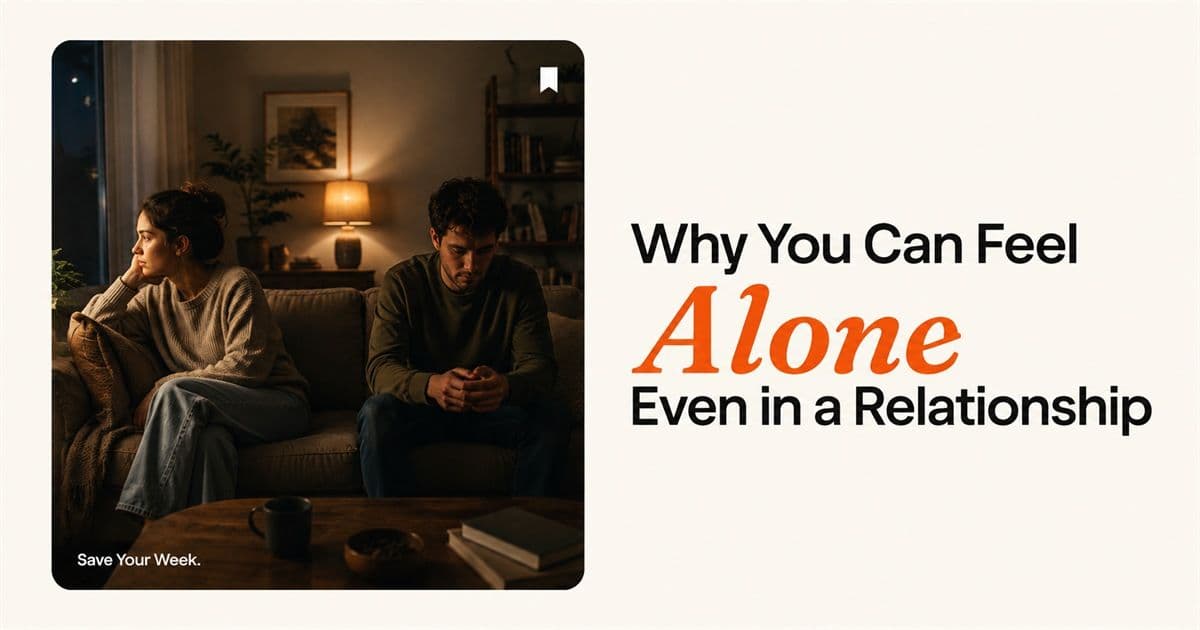
You share a home, a calendar, meals, and messages. From outside, you are clearly together. Yet when something matters, you do not know how to reach each other. Feeling alone in a relationship often begins in that gap between being near someone and real contact that lands.
Feeling alone in a relationship does not mean the relationship is over. It does not mean either person is broken. It means your contact is not creating the connection you need right now, and that deserves a closer look.
Proximity is not the same as connection
The World Health Organization's social-connection report separates different sides of connection. A person can have plenty of contact and still feel lonely. So more time together is not always the answer when you are feeling alone in a relationship.
A 2024 study across close relationships found that lonely people tended to see their partners as less caring and less admiring. This bias could then lower relationship quality and keep the loneliness going. This was a project with many studies, not a diagnosis of any one couple. Your view can be biased. But a partner can also truly fail to respond. Both things matter when you are feeling alone in a relationship.
The key move is to test what "alone" actually means in your situation.
Feeling alone in a relationship: name the missing form of connection
Who do you want to reach? The partner in front of you, a friend, family, your community, or yourself? One relationship cannot supply every kind of belonging. Feeling alone in a relationship may be about one missing form of contact, not every form.
What exactly is missing? It could be attention, affection, practical help, emotional understanding, shared meaning, honest conflict, or reliable follow-through. When is the loneliness strongest? Maybe after work, during social events, in bed, or when you share good news. Where do your attempts at connection fail? Why might each of you be unavailable there? How could one small, clear behavior change that moment?
"Be more present" is hard to act on. "When I share something important, please put the phone down for ten minutes and ask me one question" is testable. That specific request turns feeling alone in a relationship into something you can actually review.
This issue touches People, Peace, and Sleep. Late-night disconnection can disturb sleep. Being tired can then make attention harder the next evening. That Life Link points to more than one fix, not one single cause. Balencia can keep those Chapters visible when feeling alone in a relationship keeps coming back.
Look at the cycle, not only the person
In The Good Life, Robert Waldinger and Marc Schulz draw on decades of research. They argue that relationship quality matters deeply. The book offers a useful lens for reflection. Still, findings from one long study should not be treated as true for every culture and every situation.
Instead of "You never care," map the cycle instead. You hint. Your partner misses it. You withdraw. They assume you need space. The distance grows. Or you ask directly, and they dismiss you again and again. Now the evidence points toward a boundary, not a better way to talk. Feeling alone in a relationship often lives inside that cycle.
Mixed outcomes matter too. One better conversation is encouraging, but it is not proof the problem is solved. Repeated dismissal is also data.
Review connection from both directions. Ask not only "Do they understand me?" but also "Have I made the need clear, and how do I respond when they reach for me?" This does not split the blame equally. It checks your own part. It leaves the other person's responsibility in place. Sometimes the answer is a new habit. Sometimes it is grief over a relationship that cannot give what you need. Feeling alone in a relationship can be either signal.
Loneliness can hide inside efficient partnership
Some relationships run well as systems. Bills get paid, kids get picked up, meals get made, and calendars line up. The practical side can be strong. Yet real emotional contact may have grown rare. Neither fact cancels the other. Feeling alone in a relationship can sit right next to excellent logistics.
This can make the loneliness hard to name. There is so much proof that you work well as a team. Start by telling teamwork apart from felt care. When you share a worry, does the other person notice and stay with you? When something goes well, can you celebrate together? Can either of you ask for comfort? Or do you get advice, correction, or a new problem instead?
Practical teamwork is worth protecting. The goal is not to dismiss it. It is to notice which form of connection needs attention when you are feeling alone in a relationship.
Use requests that reveal compatibility
A clear request is not just a way to communicate. It creates real evidence about someone's willingness and ability. Ask for something specific, reasonable, and relevant. Try ten uninterrupted minutes, a weekly walk, affection when you arrive home, or a talk before a shared decision. That request tests feeling alone in a relationship against real behavior.
Then watch for more than the first answer. Does the person negotiate honestly if the request does not fit? Do they remember, repair when they miss it, and make an effort? Or do they mock the need, agree just to end the talk, or punish you for raising it?
You are not testing whether a partner can be perfect. You are learning whether the relationship can respond to a real need through talk and follow-through. A repeated need deserves a direct answer, even when the relationship works well in many other ways. Cia can help you place one request and one check-in point in the week when feeling alone in a relationship keeps scoring high.
Build connection beyond the couple without avoiding the couple
Friends, family, faith communities, coworkers, and groups can offer forms of belonging a partner cannot. Growing your connections can ease the pressure on one relationship and restore parts of your identity. It does not erase feeling alone in a relationship if the loneliness is specifically about the partnership.
It should not become a way to keep the real problem permanently unspoken. If the loneliness is specifically about the partnership, support elsewhere can make you stronger for an honest decision. But it cannot answer your partner's willingness for them.
Review safety and power too. Say attempts to connect lead to fear, spying, shame, or control. Then the problem is not a better date night. Seek expert support instead. Where both people are willing but stuck, good couples therapy may help map the cycle and try new responses.
If the answer stays unclear, agree on a review point instead of stretching the uncertainty without limit. Feeling alone in a relationship deserves a deadline for review, not endless hope with no evidence.
Your four-minute Action
Complete this request:
"When ___ happens, I feel disconnected. Could we try ___ for ___ minutes, then check whether it helped?"
Choose one specific moment and one small behavior. Examples include a ten-minute phone-free check-in, one walk together, or asking before offering advice. The benefit is turning feeling alone in a relationship from a final verdict into something you can both see.
A coach can help clarify the Goal, spot the connected Chapters, and review what happened after the request. In Balencia's model, the coach cannot decide what your relationship means. You confirm the Action and keep the agency.
Do not treat one missed request as the full verdict. Choose a fair length of time to watch for the need. Then review the response, the repair, and the follow-through. Closeness grows through repeated small moments. Repeated absence of care also deserves to be named, without playing it down. That review is how feeling alone in a relationship becomes something you can act on.
Frequently Asked Questions
Is feeling alone in a relationship proof that my partner does not love me?
No. Feeling alone in a relationship may reflect mismatched needs, habits, stress, perception, conflict, or genuine unresponsiveness. Look for a repeated pattern, and talk about it safely.
Can I keep feeling alone in a relationship if we spend every day together?
Yes. How often you have contact and how understood you feel are different things. Feeling alone in a relationship can continue right inside busy shared days.
Should my partner meet all my emotional needs?
No. One person usually cannot give every kind of support. Close relationships matter. So do wider friendships, family, community, and professional support. Feeling alone in a relationship still deserves a direct talk about the partnership itself.
When is couples therapy appropriate for feeling alone in a relationship?
Consider qualified help when the pattern is ongoing, distressing, or hard to discuss safely. If abuse or coercive control is present, seek specialist safety support first. Joint therapy may not be appropriate in that case.
Sources
Robert Waldinger and Marc Schulz, The Good Life
Why Do We Become the Person We Once Hated?
Tags
Did you find this article helpful?
About the author

Written by
Hamza Muqeem
Published
Put this into practice
Balencia turns advice like this into a plan that adapts to your week, with an AI coach that actually remembers what you told it.
Start free