On this page
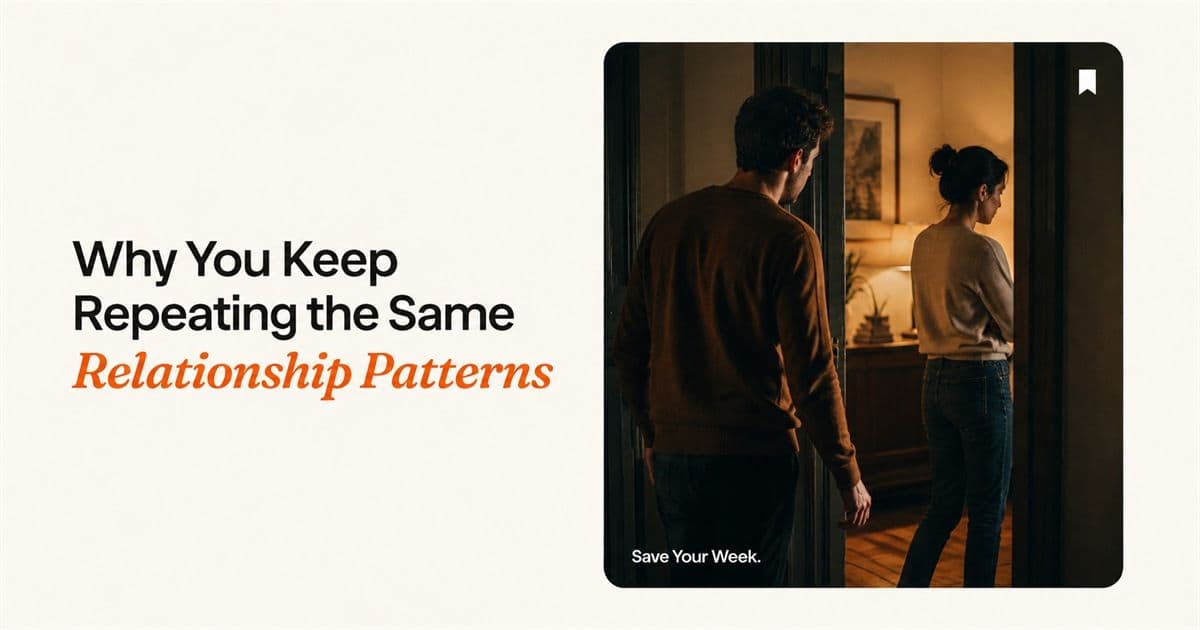
The faces change, but the ending feels familiar. You chase someone who pulls away. You go quiet until resentment builds. You ignore a boundary, or you leave right as closeness gets serious. Asking why do I repeat relationship patterns is often the first honest step after you notice this.
Why do I repeat relationship patterns? Usually because each step makes sense in the moment it happens. The way out starts by mapping the sequence, not by giving yourself a permanent label.
A pattern is an interaction over time
Attachment research can offer useful language, but online labels often turn a spectrum into an identity: "I am anxious," "They are avoidant," "This pairing can never work." A meta-analysis of 224 studies found that adult attachment anxiety and avoidance were linked to mental-health outcomes. A review of couple conflict explains how conflict can trigger attachment patterns.
These are links and frameworks, not verdicts. They do not diagnose you, prove why you picked a partner, or excuse harmful behavior. They also do not fully answer why do I repeat relationship patterns in your specific week.
The more useful unit is one specific cycle. For example, one person feels ignored and criticizes. The other feels attacked and pulls away. The withdrawal raises fear. The criticism grows sharper. Both people are trying to protect themselves. Together they create the result neither one wants. Seeing that cycle helps more than a slogan about why do I repeat relationship patterns. Write the cycle down once before you ask why do I repeat relationship patterns again.
Why do I repeat relationship patterns? Find the earliest choice point
Ask who takes part in the cycle, while keeping differences in power and responsibility in view. What is the first thing an observer could see? When does the tension start to rise? Where does it usually happen: by text, after work, around family, or during money talks? Why does each protective move feel necessary? How does the cycle end? Those questions turn why do I repeat relationship patterns into a map.
Do not start with the worst moment if an earlier one exists. The choice point may be the first sharp comment, the unread message, the guess about intent, or the talk that started while both of you were exhausted.
The pattern may cross People, Peace, Sleep, and Wealth. Money worry can trigger conflict. Conflict can disturb sleep. Poor sleep can shrink your patience. That Life Link is a guess to test, not a fixed diagnosis. Balencia can keep those Chapters visible when you ask why do I repeat relationship patterns again.
Replace labels with the shared enemy
Sue Johnson's Hold Me Tight encourages couples to spot their negative interaction cycle. It is a therapy-informed book, not a replacement for assessment or treatment.
Naming the cycle can turn "You are the problem" into "Here is the sequence that catches us both." But a "shared cycle" must never suggest shared blame where there is abuse, threats, or violence. In unsafe conditions, safety comes first. Specialist support comes before any mutual talk exercise. Safety first still answers why do I repeat relationship patterns when the pattern itself is dangerous.
One person can still change one step, even if the other person does not. The result may be a better conversation, clearer proof that the pattern continues, or a firmer boundary. Mixed outcomes are still useful information.
Patterns can also repeat because familiar situations are easier to read. This is not because you secretly want pain. What is familiar feels less uncertain, even when the outcome is bad. Treat that as a guess to test when you ask why do I repeat relationship patterns. Notice how fast you overlook a mismatch. Notice which behavior you idealize, and which early discomfort you explain away. The goal is better choices, not blaming your past for every choice you make today.
When a new response feels awkward, that awkwardness does not prove it is fake. Clear requests and calm boundaries often feel strange before they feel natural. Judge their effect, not their style, on the first try.
Patterns begin before the visible conflict
The repeated sequence may start at selection, not at the argument. You may be drawn to people who offer intensity without reliability. You may explain away an early mismatch. You may move fast before enough evidence exists. Or you may choose responsive people, then pull away once real closeness becomes possible. That earlier stage often explains why do I repeat relationship patterns across different partners.
Look earlier than the latest ending. What drew you in? What concern showed up first? What did you tell yourself about it? When did your usual standards start to slip? This is not an invitation to blame yourself for someone else's deception or abuse. It simply shows where your choice may have been bigger than you realized.
Current circumstances matter too. Isolation, money pressure, grief, family expectations, and limited options can shape who a person meets and what feels possible. A pattern is never only an inner flaw. Why do I repeat relationship patterns can also mean: what conditions keep recreating this same loop?
Change one side of the loop and observe
Suppose your cycle is: you chase, you get silence, you chase harder, then you pull away angrily. A new Action might be one clear request, followed by a set time to review it. That change does not guarantee a response. It does make the other person's choice easier to see, without you sending more messages. That small test is a practical answer to why do I repeat relationship patterns.
If your pattern is withdrawal, a new Action might be naming your need for space and saying exactly when you will return. This protects your own regulation while cutting the other person's uncertainty.
The outcome may feel worse at first, because the familiar sequence no longer offers its usual protection. Clear evidence can hurt. Finding out someone stays unavailable is still useful for setting a boundary. Cia can help you place one changed step and one review point in your week, when why do I repeat relationship patterns keeps coming back.
Do not turn attachment language into destiny
Attachment ideas can help describe how you feel about rejection, closeness, and conflict. They turn harmful when used as fixed types or as a way to predict who fits you. People respond differently across relationships and moments. Labels can hide what someone is actually doing right now. Labels rarely answer why do I repeat relationship patterns with enough detail to act on.
Replace "I am the anxious one" with "When contact feels uncertain, I send repeated messages and lose sleep." Replace "They are avoidant" with "After conflict, they stop responding for days with no return time." A behavior description like this creates a real Action and a real boundary.
Review change across repeated, similar situations. One sincere conversation is encouraging. A different response under the next stress is stronger proof. Where violence, coercion, or fear is present, do not treat the pattern as a shared dance. Responsibility and safety stay unequal.
Patterns change through repeated choices, not one perfect conversation. Why do I repeat relationship patterns becomes less urgent once one early choice point starts to shift. Review that choice point after your next similar stress, before you reopen why do I repeat relationship patterns as a question about your identity.
Your four-minute Action
Write one loop using four phrases:
Trigger: "When ___ happens…"
Protection: "I try to protect myself by…"
Response: "The other person then…"
Cost: "We end up…"
Circle the earliest behavior you can safely change. Choose one Action under five minutes: swap criticism for a specific request, delay a late-night talk, or name the cycle out loud. The benefit is one point of agency you can actually reach. That page is how you move from why do I repeat relationship patterns to one next step.
A coach can help compare this pattern with past evidence, test a small Plan change, and follow up. In Balencia, you do not need a relationship label or a whole-person score. Progress is whether the specific interaction changed, and what you learned from it.
Keep each person's account visible. A shared diagram can hold two different experiences. Agreeing on the sequence does not mean agreeing on every motive.
Frequently Asked Questions
Do childhood experiences explain why do I repeat relationship patterns?
Early experiences may matter, but they do not decide every adult relationship. Current partners, stress, skills, culture, and circumstances matter too. Why do I repeat relationship patterns is rarely about one single cause.
Can attachment style change if why do I repeat relationship patterns feels fixed?
Attachment is better understood as a spectrum shaped by context, not a fixed online identity. Change can happen through relationships, reflection, and treatment.
What if only I want to change when I ask why do I repeat relationship patterns?
You can change your own part and your own boundary. You cannot make the other person respond differently, so review the evidence honestly.
When is a pattern more than a communication problem?
Fear, control, threats, isolation, or violence call for a safety lens first. Seek qualified local support instead of trying to communicate your way through it. Why do I repeat relationship patterns should never delay safety.
Sources
Sue Johnson, Hold Me Tight
How to Forgive Without Excusing: Keep Boundaries Intact
Tags
Did you find this article helpful?
About the author

Written by
Hamza Muqeem
Published
Put this into practice
Balencia turns advice like this into a plan that adapts to your week, with an AI coach that actually remembers what you told it.
Start free